
Rotary Drum Dryer Product Overview
The Rotary Drum Dryer is the workhorse of industrial moisture reduction, essential for ensuring granules, like fertilizer granules, reach the required moisture, hardness and shelf-life stability.
In a fertilizer production line, the dryer follows the granulation stage. It reduces the granules moisture content through direct or indirect heat exchange, preventing caking and ensuring the structural integrity of the final product.
Applicable Materials & Fertilizer Types
EMCC Rotary Drum Dryers are suitable for:
▢ Inorganic Fertilizers Drying: NPK compound fertilizer, diammonium phosphate (DAP), monoammonium phosphate (MAP), superphosphate, potassium chloride, potassium sulfate, etc.
▢ Organic Fertilizers Drying: Humic acid, bio-organic fertilizer, livestock and poultry manure fermentation products, etc.
▢ Other Materials Drying: Mining materials, chemical raw materials, etc.
Production Capacity Range
As a high-capacity dryer, the Rotary Drum dryer’s capacity covers everything from laboratory testing to industrial-scale mass production, with a single-unit processing capacity ranging from:
▢ Minimum: 1 tons/hour
▢ Maximum: over 200 tons/hour
Customized designs are available to match fertilizer production lines of different scales based on customer requirements.
Rotary Drum Dryer Working Principle & Core Advantages
The rotary drum dryer is a continuous, high-capacity drying device widely used in fertilizer, mining, and chemical industries. Wet material enters an inclined, rotating drum and is lifted by internal flights, forming a falling “curtain” through a stream of hot gas. This maximizes heat and mass transfer, rapidly evaporating moisture. As the material tumbles forward, it is evenly dried, rounded, and polished. The dried product exits at the lower end, ready for cooling and packaging.
✅︎ High Throughput: Engineered for continuous, large-scale industrial operation with capacities reaching 200 TPH.
✅︎ Internal Lifting Flights: Specially designed “L-shaped” or “Spiral” flights lift and shower the material through the hot air stream (the Curtain Effect), maximizing heat exchange efficiency.
✅︎ Thermal Versatility: Compatible with various heat sources, including oil, natural gas, coal or biomass.
✅︎ Durable Build: Features a heavy-duty steel shell, precision-machined riding rings (tyres), and a robust gear-drive system for long-term stability.
✅︎ Sealing Systems: EMCC uses flexible leaf seals at both ends to minimize “parasitic air” (cold air leaking in), which can reduce thermal efficiency by up to 15%.
✅︎ Easy Operation: Stable operation, high degree of automation
✅︎ Convenient Maintenance: Reliable structure, few wear parts
EMCC Customization Rotary Drum Dryer Capabilities
EMCC offers full-parameter custom design based on different process requirements, including:
▢ Drum length-to-diameter ratio
▢ Drum speed and inclination adjustment
▢ The lifting plate structural form and quantity
▢ The flow direction relationship between hot air and material
▢ The hot air inlet temperature
▢ Stainless steel lining and stainless steel lifting plate for option
▢ Support for PLC automation control, integrated with complete line interlocking
EMCC Rotary Drum Dryer Technical Specifications
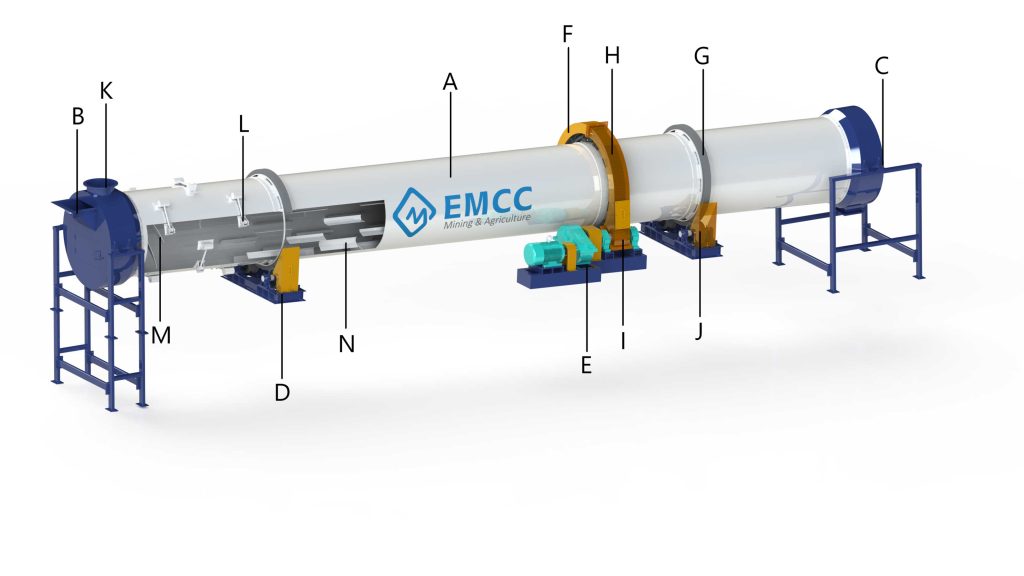
A – Cylinder
B – Feeding device
C – Discharging device
D – Support wheel assembly
E – Transmission
F – Protecting cover
G – Rolling ring
H – Big gear
I – Pinion
J – Supporting wheel
K – Exhaust gas outlet
L – Hammering device
M – Spiral blade
N – Lifting plate
O – Hot-blast Stove
P – Burner
Basic Technical Parameters Table
The above are the minimum and maximum basic parameters for EMCC Rotary Drum Dryers. For specific parameters, design drawings, or a quote tailored to your material, please 【Contact EMCC Engineer】 or 【Visit Official Website for Complete Cases】 .
Technical Deep Dive
The following content details the advantages of Rotary Drum Dryers in fertilizer production and the process pathways. For specific parameters, design drawings, or a quote tailored to your material, please 【Visit Official Website for Testing Center】 or 【Contact Engineer to Schedule Material Testing】 .
Why choose a Rotary Drum Dryer for fertilizer drying?
The Rotary Drum Dyer is the industry-standard drying solution for fertilizer granulation lines.
After wet granulation (disc granulator or rotary drum granulator), fertilizer granules typically contain 2%-60% moisture and must be dried to even ≤2% (material dependent) for safe storage, packaging, and transport. The rotary drum dryer is the most widely used drying equipment in the global fertilizer industry, capable of handling high capacities with excellent reliability. It not only removes moisture efficiently, but also further rounds and polishes the granules during the tumbling process, enhancing the final product’s appearance and market value.
How Does a Rotary Drum Dryer Produce High-Quality Dried Fertilizer Granules?
In a Rotary Drum Dryer, wet granules enter with moisture content of 2%-60% and exit at even ≤2% (material dependent), with the following quality attributes:
● Uniform final moisture content across all granules
● Enhanced granule roundness and surface smoothness from tumbling
● Granule strength increased through controlled thermal treatment
● No thermal degradation when properly designed and operated
Typical Process Pathways:
Process Type
30%–55%
Rotary Drum Dryer Design: From Standard to Custom
The structural principle of a Rotary Drum Dryer is relatively straightforward—wet material enters the rotating drum, hot gas is introduced, and moisture evaporates. However, to achieve stable production of uniformly dried product at high capacity, professional design capabilities and in-depth process understanding are essential.
We not only provide reliable products, but more importantly, we provide reliable process design and experimentation.
EMCC Focuses on the Following During the Design Phase:
● Is the material organic or inorganic? (determines maximum allowable temperature)
● What is the inlet moisture content and target outlet moisture?
● Is the material heat-sensitive? (determines co-current vs. counter-current design)
● What fuel source is available? (natural gas, oil, biomass, coal)
● What are the local environmental emission standards?
Key Design Parameters:
● Drum Diameter and Length: Determined by required capacity and retention time
● L/D Ratio: Typically 5:1 to 12:1, optimized for each application
● Flight Design: Spiral flights at feed end for forward movement, straight flights in middle for cascading, no flights at discharge to prevent dust carryover
● Gas Temperature: Precisely controlled to maximize evaporation without damaging product
● Retention Time: Determined by material drying characteristics, as details below in testing table.
The following content elaborates on how testing ensures the feasibility of the drying process and equipment performance. For testing services tailored to your material, please 【Visit Official Website for Testing Center】 or 【Contact Engineer to Schedule Material Testing】 .
Why is Testing So Important?
Conducting material drying testing at the EMCC Innovation Center allows you to:
✅ Confirm the feasibility of the intended drying process
✅ Collect key process data required for equipment design: inlet/outlet moisture, optimum temperature, retention time, airflow requirements, etc.
✅ Identify potential issues (material sticking, thermal degradation, dust generation) before scale-up
✅ Reduce project risks and avoid later operational failures and production losses
📌 Note: “Drying” here specifically refers to direct-heat rotary drying, the most common method for bulk solids in the fertilizer industry.
How Does Testing Impact Rotary Drum Dryer Design?
While a Rotary Drum Dryer may seem simple to operate, stable operation, minimal oversight, and consistent production of on-spec products are the results of a carefully designed machine from an experienced supplier. In contrast, a poorly designed dryer may face issues such as uneven moisture content, product overheating, excessive fuel consumption, or frequent mechanical failures.
A comprehensive testing program provides the following core values:
1️⃣ Assessing the Material's Unique Response to Drying —— Raw material characteristics that affect dryer design include:
▢ Initial moisture content and target final moisture
▢ Particle size distribution and bulk density
▢ Heat sensitivity and maximum allowable temperature
▢ Abrasive or corrosive nature
▢ Stickiness or tendency to agglomerate
▢ Dust generation potential
Testing helps determine the parameters needed to achieve the desired product from a specific raw material and whether pretreatment steps are required.
2️⃣ Gathering Key Process Data
Optimal drying is achieved by controlling moisture removal through a matrix of process parameters based on material behavior. Key data points focused on during testing include:
Feed rate and drum fill percentage
Designed TPH ±12% variation typical. 10%-20% fill optimized for “Curtain” density. Determines equipment size and capacity matching.
Determines the “curtain” density of cascading material, affects heat transfer efficiency. EMCC utilizes various flight designs (L-shaped, radial, and spiral) to suit material stickiness. Drum rotation speed: 1.8-8rpm (VFD adjustable)
60-90℃ Prevents granule melting
3️⃣ Identifying Potential Issues and Mitigating Risks Early
Materials successfully dried on a batch/bench scale often present unpredictable issues upon scale-up. Pilot-scale testing can identify these issues early, allowing engineers to adjust the design before equipment fabrication, avoiding later modifications and losses. Common scale-up issues include unexpected material sticking to internal surfaces, excessive dust generation, and uneven residence time distribution.
Additionally, testing helps operators gain an in-depth understanding of material drying characteristics, accelerating future troubleshooting, such as identifying process fluctuations caused by raw material moisture variation.
Rotary Drum Dryer Frequently Asked Questions (FAQ)
The following FAQ covers equipment selection, process design, capacity matching and maintenance. For a specific solution tailored to your material, please [Visit the EMCC Main Site to View the Complete Product Line] or [Contact an Engineer for a Free Assessment].
Answer: The rotary drum dryer is a core piece of equipment in fertilizer production (especially for organic, NPK and compound fertilizers). The primary reason is that the “wet granules” coming directly out of the granulator cannot be directly packaged or used for planting; they must be dried.
Details available in the original article >
Answer: There are two basic types of Direct Fired Dryers: Concurrent (or parallel flow) and Countercurrent (or counter flow)
In both types of dryers, the material to be dried comes into direct contact with the hot process gases. These gases are generally provided as products of combustion from an oil, gas or solid fuel fired furnace .
Details available in the original article >
Answer: Uneven moisture content is one of the most common drying issues, typically caused by a combination of factors rather than a single fault. Systematic troubleshooting should check:
Checkpoint | Normal Expectation | Abnormal Indicator | Adjustment Direction |
Internal flights/lifting plates | Evenly distributed, intact | Worn, damaged, or fallen off flights | Replace or repair damaged flights to restore proper material cascading |
Feed rate consistency | Stable, within designed capacity range | Fluctuating or exceeding rated capacity | Optimize feed rate and maintain consistent material flow |
Airflow and exhaust | Proper exhaust fan speed, clear ductwork | Insufficient ventilation reducing heat transfer | Adjust airflow and clean ducts regularly |
Burner temperature settings | Set for optimal drying range | Too low to achieve proper moisture removal or too high causing scorching | Check burner settings and adjust temperature accordingly |
Material clumping before entry | Free-flowing, no large lumps | Agglomerated wet lumps entering drum | Break up clumps before feeding into the dryer |
In practice, uneven drying frequently traces back to worn internal flights that fail to properly lift and cascade material through the hot gas stream. Regular internal inspections during planned shutdowns are essential to catch this early.
Answer: Scorched or discolored material indicates the product is being exposed to excessive heat. This can damage product quality and create fire hazards. Primary causes include:
Burner temperature too high: Reduce burner temperature to the optimal drying range for your specific material
Insufficient material feed: Not enough material in the drum to absorb the heat; increase feed rate to match the thermal input
Drum rotation speed too slow: Material stays in the high-temperature zone too long; adjust drum speed to reduce residence time
Faulty temperature controls: Temperature sensors or thermostats may be malfunctioning — calibrate sensors and replace if needed
Critical safety note: If you detect smoke or a burning smell, shut down immediately and allow the equipment to cool thoroughly before investigation.
Answer: Excessive fuel consumption usually stems from heat loss or inefficient heat transfer. Key areas to investigate:
Cause | Solution |
Poor insulation | Improve thermal insulation to reduce heat loss from the drum shell; seal gaps with heat-resistant materials |
Air leaks in the system | Inspect seals and ductwork; repair any leaks that allow cold air ingress or hot air escape |
Incorrect burner air-to-fuel ratio | Optimize burner settings for the right mixture; improper ratios waste fuel |
Excessively wet feed material | Extremely high moisture feed demands disproportionately more energy; consider pre-drying to reduce initial moisture content |
Worn breeching seals | Damaged seals at the feed and discharge ends allow false air to enter, reducing thermal efficiency — repair or replace as needed |
According to EMCC, worn dryer seals are a frequently overlooked cause of efficiency loss, as they disrupt the precise internal temperature balance designed into the system.
Answer: Abnormal noise is a critical early warning sign of mechanical issues. Different sounds point to different root causes:
Noise Type | Likely Cause | What to Check |
High-pitched squealing or rattling | Bearing damage (poor lubrication, wear, contamination) | Check all bearing lubrication; listen with a listening rod to isolate the damaged bearing |
Knocking or clunking | Excessive gear meshing clearance, worn gear teeth, or loose lifting plates | Inspect gear backlash (standard: 0.15-0.35 mm); check internal flight attachment |
Grinding | Insufficient gear clearance, or mechanical interference between drum and fixed structures | Inspect gear mesh; check for friction marks on drum shell and protective covers |
Periodic thumping | Loose lifting plates or foreign objects tumbling inside the drum | Open manhole door for internal inspection; check for fallen liners or debris |
Troubleshooting sequence: Safety first — shut down and lockout/tagout before any close inspection. While running (if safe), try to locate the approximate source: drive end, middle section, discharge end, or roller support area.
Answer: Drum vibration is a serious issue that, if left unaddressed, can lead to shell deformation, bearing failure, and structural damage. Major causes include:
Mechanical imbalance: Uneven material distribution inside the drum, severely worn or missing lifting plates, or uneven scale buildup on the internal walls. Clean the drum interior and replace damaged flights.
Loose foundation or anchor bolts: Thoroughly inspect and tighten all anchor bolts and equipment connection bolts, including roller bases, reducer base, and motor base.
Worn, out-of-round rollers or trunnions: Measure roller diameter and check for uniformity; rollers that are out of round will cause the drum to “bump” with each revolution.
Misalignment: This is one of the most common root causes of vibration. Use a laser alignment tool or dial indicator to accurately measure and adjust the drum’s positioning.
Answer: If the drum moves sluggishly, stops intermittently, or the motor overheats, check immediately:
Overloading: Ensure the drum is not filled beyond its rated capacity. Overloading strains the motor and drive system.
Seized bearings: Lack of lubrication causes excessive friction and prevents smooth rotation. Inspect, lubricate, or replace bearings as needed.
Motor or gearbox failure: Electrical or mechanical issues with the motor or gearbox require professional inspection and repair.
Broken drive belt or chain: Loss of power transmission from worn or broken belts/chains. Tighten or replace immediately.
Answer: Alignment is one of the most influential factors affecting a rotary dryer’s service life. When a dryer is misaligned, all structural and mechanical components experience excessive stress.
Signs of misalignment:
- Chattering, grinding, or other abnormal sounds
- Visible wear or damage to tires (riding rings) and trunnion wheels
- Visible wear or damage to pinion and girth gears
- Improper contact between tires and trunnions
Why misalignment occurs: Even a properly commissioned dryer can fall out of alignment over time due to foundation settling, worn components, changes in process conditions, or improper float maintenance between thrust rollers.
The solution: EMCC recommends laser alignment as the modern standard. A laser tracking system creates a 3D spatial map of the drum and calculates precise base adjustments. This method is significantly faster and more accurate than traditional manual alignment techniques.
Answer:
- Float refers to the positioning of the drum between the uphill and downhill thrust rollers. Ideally, the drum should “float” between them, not riding hard against either one.
- Thrust rollers prevent the drum from drifting longitudinally (typically downhill). Intermittent contact between the tire and thrust roller is acceptable, but continuous pressure will damage both components and put excessive load on bearings and shafts.
The process of correcting drum float is called “training” the drum. This is done by skewing trunnion bearings in very small increments to influence the drum’s longitudinal movement. This should only be performed by trained professionals, as incorrect adjustments can cause extensive damage.
Answer: EMCC, with 20+ years of rotary dryer expertise, recommends:
Daily/Weekly Inspections:
- Monitor and document key measurements: tire creep, cold gap (for floating tire assemblies), drum float on thrust rollers, and bearing temperatures
- Check lubrication of all components — both under-lubrication and over-lubrication cause problems
- Listen for any unusual noises or observe any changes in vibration
Monthly/Quarterly:
- Inspect internal flights and liners for wear, looseness, or loss
- Check breeching seals at feed and discharge ends for leakage
- Inspect gear teeth for wear patterns
Annually:
- Arrange a comprehensive dryer audit by the OEM or a qualified service provider for deep mechanical inspection
- Perform precision alignment checks using laser alignment methods
- Benchmark all key measurements against historical data for trend analysis
Critical Practice: Keep a thorough parts inventory of wear-critical spares (bearings, seals, belts). Having the right replacement parts on hand can mean the difference between days and weeks of lost production.
Answer: This is inherent to rotary dryer dynamics. The process exhibits transport delay — changes to the drying gas parameters affect outlet moisture only after the material has traveled through the entire drum length, which can take many minutes. This delay, coupled with strong thermal inertia from the large thermal mass of the drum and material, means that operators must be patient: allow at least one full residence time for the effect of any adjustment to stabilize before making further changes.
Why Choose EMCC
10+ Years Industry Experience
Dedicated to providing granulation, drying, cooling, and conveying solutions of various raw materials.
100+ Global Sucess Cases
Standardized service procedures and comprehensive after-sales ensure smooth project execution.
50+ Persons Design & Service Team
Access to consultation, design, machines, installation, training, on-site guidance, spare parts, and daily maintenance.
Dedicated to providing granulation, drying, cooling, and conveying solutions of various raw materials.
Integrated Steel Plate Fabrication
Max. drum-type equipment processing: Ø4.5 m, Robust structure and high-quality components extended service life.
Standard Service Process
Consultation > Trial Analysis > Solution Design > Quotation & Contracting > Equipment Fabrication > Assisted Installation & Commissioning > Ongoing After-sales Support